Showing posts with label damascus. Show all posts

Monday, November 15, 2010

Syria : The Whirling Dervish in Damascus

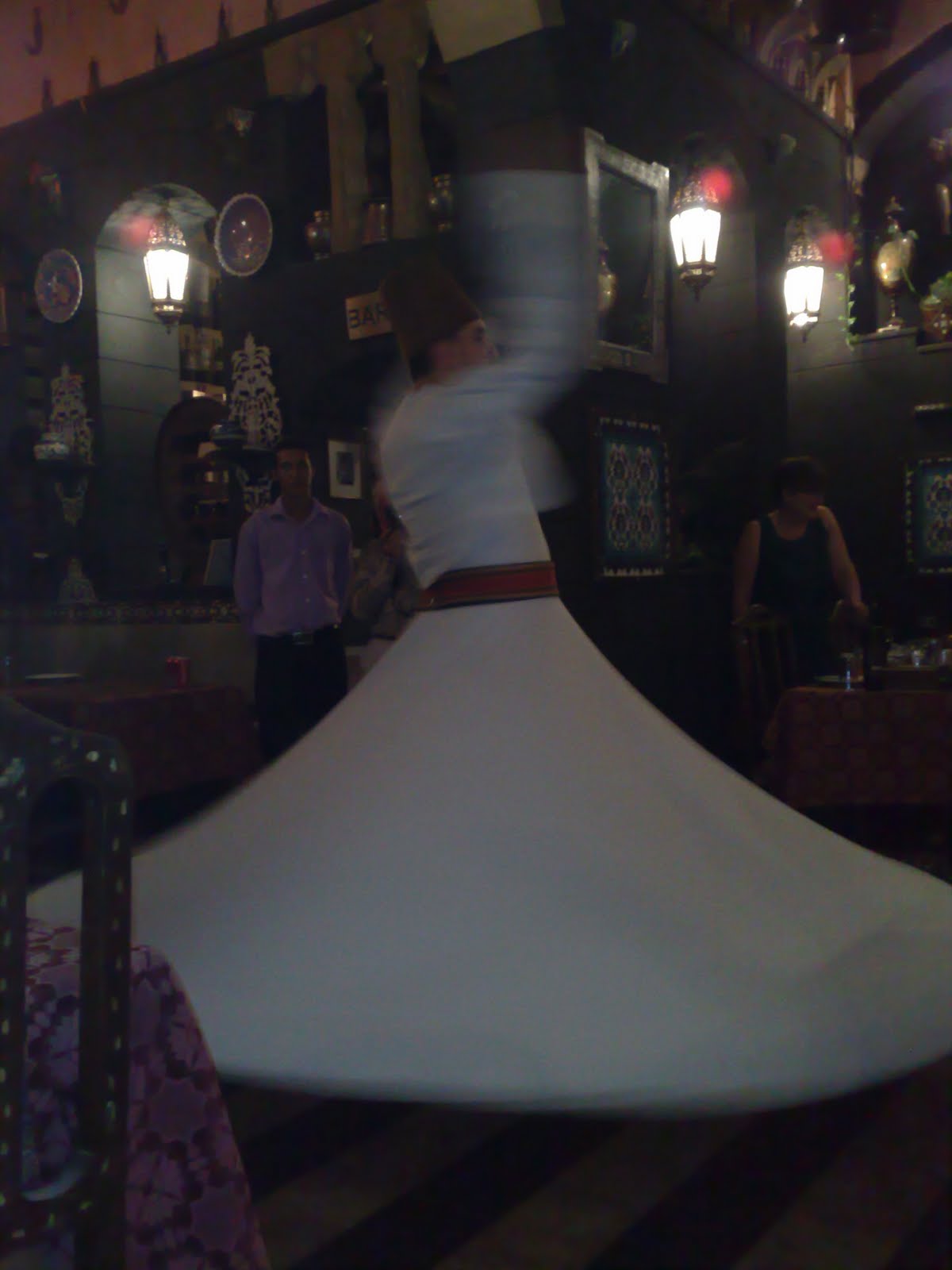
During a dinner at a restaurant in the Christian Quarter in Damascus, we had the privilege of being entertained with a whirling dervish dance.

I have seen this dance many times on TV's travel channel; this is the first time live, and it was a lone dervish. He performed a few sets of the dance, and spun so fast it was amazing that he didn't lose his balance or trip or feel giddy.

Each dance was to the tune of (Sufi?) music - which I find haunting- and ended abruptly with a loud stomp on the floor. The skirt swirled and billowed perfectly it seemed like it was either made of a stiff material or starched to perfection.

Although it was understood that the dervish dance was put up for the tourists, I thought the dancer was in an actual trance as his expressions and his eyes appeared so. He has to be, right? I don't think they can just perform the dance 'for show' only.

The information for the captions below are sourced from here; and there is a whole load of further information on dervishes and Sufism out there in the great big world of Google.

"The whirling dervish dance originated in Konya, Turkey, inspired by the songs and teachings of the poet Mevlana Jalaluddin Rumi, who lived from 1207-1273. Rumi was a Sufi, a branch of Islam that started in the 8th century. Sufis assert that through their religion they are brought closer to the heart of all modes of belief. Rumi himself was moved to begin dancing in dervish fashion after meeting a holy man known as Shems of Tabriz. The dance, in which he spun incessantly, was done in devotion to Allah and the organic powers of the universe. While he whirled, he repeated the name of god until he fell into a trance state of deep worship".

"The whirling dervish is known as a Semazen. Dervish itself means doorway to god or enlightenment. Sufism is derived from the word for a rough, woollen cloak, its material designed to diminish the superficial pleasures of worldly existence. Mevlevis are the order of Sufis that perform the whirling dervish dance, refered to as the Sema. The leader of the group is called the Sheikh; he often stands in the middle of the room, representing the sun, while the other members dance around him in imitation of the cycles of the planets. The repetition of god's name is the Zikr".

"Whirling dervishes sport a conical hat and a white shirt and skirt. The skirt is made of billowing material that flows out and around the dancer as they spin. The headgear symbolizes the need to seal off one's ego in order to connect to god and the universe. The skirt represents a shroud but also the sky, which is revealed as the dancer removes their black cloak and begins the journey towards spiritual enlightenment".

"As they whirl, always from right to left, thus in the motions of the blood circulating around the heart, the Dervishes hold their hands in a unique position. The right hand is lifted, palm-out, towards god and his gifts. The left is palm down towards the earth, to both draw forth its sustenance and to deliver god's gifts of the spirit to humanity. The dancers usually spin to the sounds of a reed flute. The flute symbolizes how human pain (the holes in the flute) can be transformed into beautiful music and a source of celebration".

At the end of his performance, the dancer - hot and sweaty - changed out of his attire and into his daily clothes. Maybe after this restaurant he's off to another place for his next show.

To sum up the experience : fascinating. Made me wish that one day I can watch a big group of dervishes perform the dance in perfect unison. Preferably in Turkey.

Tuesday, October 26, 2010

Syria : Minding the Language

For the first time, I thought that maybe those Kelas Bahasa Arab many many years ago back in secondary school may finally have some use during the Syria-Jordan trip.

In truth, sadly, I remember only remnants of it; very very little, negligible, except for the numbers; I can remember them and can count from 1 to 8 :-P.

Okay enough school stories. Knowing the Arabic language is definitely an advantage when travelling in the Middle East.

In Damascus' Christian Quarter, we found this beautiful copy of The Bible, The New Testament, printed in Arabic.

The shopowner was kind enough to let us browse through it - though I don't really know what to look for since I could not read it.

This has an interesting story - I was exploring Aleppo on Sunday morning and walked into the Syriac Catholic church where the mass was halfway. I stayed on and experienced my first ever mass in Arabic! It was almost ... surreal. After the mass ended I asked a gentleman there whether there was a bookstore in the Church for me to buy some books or stuff. He said there is none and the markets are closed too, and promptly asked me to wait as he will ask the priest! Long story short, I was introduced to the priest who invited us inside the rectory and into his office and presented me with this small maroon Bible.

The New Testament.

Guess why I put up this picture?
(i) to show the number plate (I know my Arabic numbers, ngeh)
(ii) it's a Proton! (why are we always excited to see a Proton overseas?)

I thought - wouldn't it be nice to be able to read this?

This seems to be some kind of award or royal recognition.

At the Umayyad Mosque.

You can find a few street signages like these in Arab and English. This area was where we wanted to head first in Damascus but we could not find it and the taxi driver ... well, did not know either.

There are a few English adverts posted in the Christian Quarter - I am guessing more expats live there. (Exchange Partner??? ;-P)

Well, amidst those there are 'clever' signboards like this - with pictures! You definitely know what they're selling :) By the way, these shops are equivalent to fast food outlets in Syria since they do not have any Western food franchises.

Learn the numbers, and some useful phrases - that will help a lot in your travels.

Friday, October 22, 2010

Damascus : The Public Bath of Courage

What's hidden behind this curtain?


I wish I had more pictures to show here, but this is the only one I have.

So, where does this entrance lead you?

Well, behind this curtain, there is a door that leads to Hammam Ammoonah.

To enter you need to ring the doorbell and then after verifying you're a female they'll let you in. Oh, this is a women's hammam so it's off limits for men. The door is not even marked nor is there a signboard or a signage, we actually almost missed it the first time.

From its pamphlet :

Built in the 12th Century A.D., this authentic public bath was formerly known as "Hammam Shooja" (The Public Bath Of Courage) until the late 18th century when it was renamed to its present day name. During the Ottoman era, Hamman Ammoonah was classified amongst the cleanest public baths in the city of Damascus; however it was completely neglected in the later periods. In an endearing effort to maintain its hereditary value, we have fully restored and renovated this historic space with our personal touch, hoping to provide you with an authentic bathing experience.

One of the to-do things in my list was to try out a hammam.

The experience at Ammoonah?

For 850 SYP, you get bathed, body-scrubbed, foot-scrubbed, rubbed and massaged. Plus a bar of soap, a bottle of shampoo and scrubbing pad, and refreshment.

The bossy lady who appeared to be the one in-charge explained the services - first a sauna, then you bathe (hot and cold water available, not shower), followed by scrubbing, bathe again, rubbing, then bathe again. It was still kind of confusing at first, maybe they expected you to know what to do and where to go?

Ooo-er, this is not for the bashful. They don't call it the Public Bath of Courage for nothing! One can strip buck naked, or opt to leave your undies on for modesty. They do provide you a towel but that comes straight off as you enter the bathing area.

Inside (the reason why no cameras are allowed, except in the sitting area) there were women in assorted sizes, shape, colour, all subjecting themselves to the skilled and experience hands of the Hammam staff.

You definitely need a HUGE DOSE OF COURAGE for this, it is one thing to get naked and another to undergo the seemingly barbaric scrubbing.

The lady who does the scrubbing did so with such vigour and enthusiasm that I felt my skin probably got scrubbed off together with the layer of dead skin and dirt that's caked on it. OOWWWWWWW! was my reaction the first few seconds. After I got used to the level of pain (yes, just a little bit, after that it was tolerable) I find myself trying hard not to giggle and laugh out loud :) Yeah, it got kind of ticklish, haha.

The scrubbing lady was built like a 2-tonne truck with huge strong arms (think wrestler!). There were two of them and I thought, hey which one is gentler? She scrubbed and scrubbed and scrubbed and pulled my limbs up down and to the sides - I switched off, stopped myself from thinking and feeling anything and just allowed her to do her job.

Now I know what piece of meat feels like. As I lay face down on the wet floor, face literally millimetres away from the surface, I saw the water flowing with bits of dirt with it and thought : where does all this water flow out to? Is this floor clean? Is the scrubbing pad clean? What if it's dirty? (horror!) Is she laughing at my body? What does she think of those callouses on my feet? My toes!? How many thousand bodies has she scrubbed? And yadda yadda yadda my brain asked endless questions.

And during all these, other girls are entering and exiting the bathing area. I think all of us were quite conscious of being naked/almost naked, best thing to do is lower your gaze and maybe try to avoid eye-contact? There were some tourists just like us, and we exchanged amused looks throughout.

Once you're done you exit the bathing area and go to rest at the elevated sitting area while they serve you drinks of your choice, hot or cold.

This gives you a chance to recover from the shock and horror, check out your limbs and body for bruises or signs of abuse, and hey! There is none! You aren't even beet red after all that scrubbing. The skin does look clearer and feel much smoother. No pain no gain? You bet.

You know what, after this experience, I'd go to a hammam again in a heartbeat. If they only have them in Malaysia that's affordable.

And the scrubbing lady must look like a wrestler for maximum effectiveness :)

Wednesday, October 20, 2010

Damascus : How To Treat Yourself on A Tight Budget

Because earlier today, 20.10.2010, it was extremely hot, I am inspired to write ... an ice-cream post.

When we were in Syria, trying to stay within budget, we only allowed ourselves one luxury. And that's ice-cream.

In particular, the ice-cream at Bakdash, located within Souq Al-Hamediyya.

Never a lull moment. Its walls are adorned with old pictures as well as pictures of famous people (we guessed) who have been there. There was even a picture of the King of Jordan if I am not mistaken.

You can order after getting a seat or at the counter. Getting a seat can mean waiting, though not for too long.

Well, actually our first ice-cream was from another shop, with no English name. It's located in the first few ' blocks' of the souq so on a hot hot day, when we saw ice-cream, we went in and had some.

First Shop Ice Cream - Puddings in the cold cabinet.

I had this. Yummy.

Julie had this. Light and quite yummy too.

Then, in the following days, after discovering Bakdash, we devoted ourselves totally and pledged undivided loyalty had eyes for no other :P

Only 50 SYP! The Arabic ice-cream costs 75SYP.

It has its own cutlery that's marked 'M.H. Bakdash Est 1895. Damascus Syria'

Don't be startled when the pounding starts! This is to make the Arabic ice-cream (Hey, that's Freddie Mercury, we thought!)

Sometimes there's two of them - The Mighty Ice Cream Pounders. I thought, whoa, if I did this daily I'd get those defined biceps I've always wanted! :)

This is how the blocks of ice-cream look like before it is savagely pounded. Afterwards they look like Swiss rolls after crushed pistachios are sprinkled on.

Tried to pound the ice-cream, and an excuse to take a picture with Freddie Mercury :)

A staff cutting portions off a bigger block of ice-cream.

The perpetually busy pick-up counter, that's manned by at least ... 5-6 people at one time? Understaffing issues don't exist here.

View from outside - look at that melting yumminess in the foreground!

I found it strangely addictive. Is it the finest I've ever eaten? No, I don't think so. But there is something about the taste that is different from franchise ice-cream. Maybe the ingredients are all organic, local and natural? And maybe because it was always always very hot in Damascus :)

Yummy.

Last day treats : the one on the left is a strawberry vanilla cone I think, and the one on the right is the Arabic ice-cream. I think the very last ice-cream was a take-away cone? Or was that the day before?

Anyway, I would recommend Bakdash as a must-go, must-eat in Damascus even though we were told by Othmen the shopkeeper that they are not actually The Best; they are like number 3 or 4. Number 1 is located somewhere else in another part of the city.

I'm not picky about rankings, so to me Bakdash is No. 1 :).

A most valuable discovery on a hot day.

Damascus : Ancient. Very Very Very Old.

So, just how old is the city of Damascus?

Truthfully, at first, I thought maybe it is more than a thousand years old. Then I found out later, according to my good friend Google, the city has been around since 6300 BC. Other findings suggest that it dates as far back as 9000 BC! Mind boggling, my imagination is stumped.

Historians do generally agree that Damascus is the oldest continuously inhabited city in the world.

We stayed at a few minutes walk from the Old City area - which made walking to the main bazaar, Souq Al Hamediyya, a breeze.

UNESCO World Heritage Site status accorded in 1979.

Landmarks and signages.

Souq Al- Hamediyya, the main souq/bazaar. It's a looong walk to the other end.

As with other Middle Eastern souqs, there are many many many things on sale. From clothing and footwear to fabrics and crafts and of course, souvenirs for tourists. Many Arab tourists - from Lebanon, Jordan - flock to Syria to shop because it is the cheapest country in the neighbourhood. We likened it to our own MY-SG relationship :)

Snack cart - breads and pastries.

All sorts of tableclothes and other things to dress your tables with.

Statue of Salladin near the Citadel entrance.

Covered ladies - there's many and I learnt about the differences in how their cover-up or wear their robes/veils.

Tea seller at the entrance of the Souq.

Sand art in bottles. They're really skilled.

What are these? Fridge magnets.

View of The Western Gate.


A beautiful courtyard restaurant - it didn't look much from the outside though. This one had some sort of royal recognition at the door.

Another neighbourhood shop - a bakery that sold the cheapest pastries! Simple but filling.

Flat breads are baked in a traditional oven.

Shisha/nargileh/hookah paraphernalia sold from a 'sunken' (below road level) shop lot. Never tried it - I can't get my head around the hygiene issue.

At the other side of the city, you can see a mixture of old and new. Some old buildings are left to rot. Literally.

The walls looked like they're made of mud, wood and straw.

Al-Merjeh - Martyr's Square. A landmark that is quite close to the backpackers' favoured area. Apparently the immediate area is city's red light area too?

The National Museum is closed on Tuesdays. Duh. But we did spend time at another building across which had the Silk Road Festival 2010 Exhibition.

This outdoor area displayed bits of ruins and other artefacts was closed off for some upgrading/restoration work.

I enjoyed the Silk Road Exhibition - small and simple, yet interesting. And because they had things to sell that we can buy :)

Another beautiful cosy courtyard - at the Al Rabie Hotel. If you want to stay at a place with character, this is a good choice. A backpackers' haunt, thanks to LP. We did not stay here as it was beyond our budget. Peak season.

I am guessing that these are bits of ruins; instead of putting them back together they are simply arranged as part of the landscape decorations along the road.

I love this white gate and its columns that indicates that you have arrived at the Christian Quarter.

A water wheel atop Pizza Bab Kissan.

Along Medhat Pasha, towards the Christian Quarter.

Obligatory foot shot.

Anyway, Damascus is not all old-city. On the 3rd day, our kind driver brought us up Mount Qaissoun to enjoy the sunset, and, oh boy, the view was awesome! The city is freaking huge, and we totally did not venture to the more modern parts. And the sight of this mountain at night? Like a whole mountainside covered in fairy lights! Unfortunately I did not manage to capture this with my camera, I think a fancy camera (read : DLSR) is needed!

Time to save for a new toy, perhaps?